
The Prep Agenda for a First Scent Factory Conversation
The first call with a fragrance factory is not a pitch meeting; it is an information exchange that should end with a sampling plan. That outcome depends almost entirely on preparation: a one-page brief, three reference scents, a volume and price scenario, and a written list of questions. Brands that arrive with adjectives instead of references usually leave with a catalogue instead of a plan.
Key takeaways
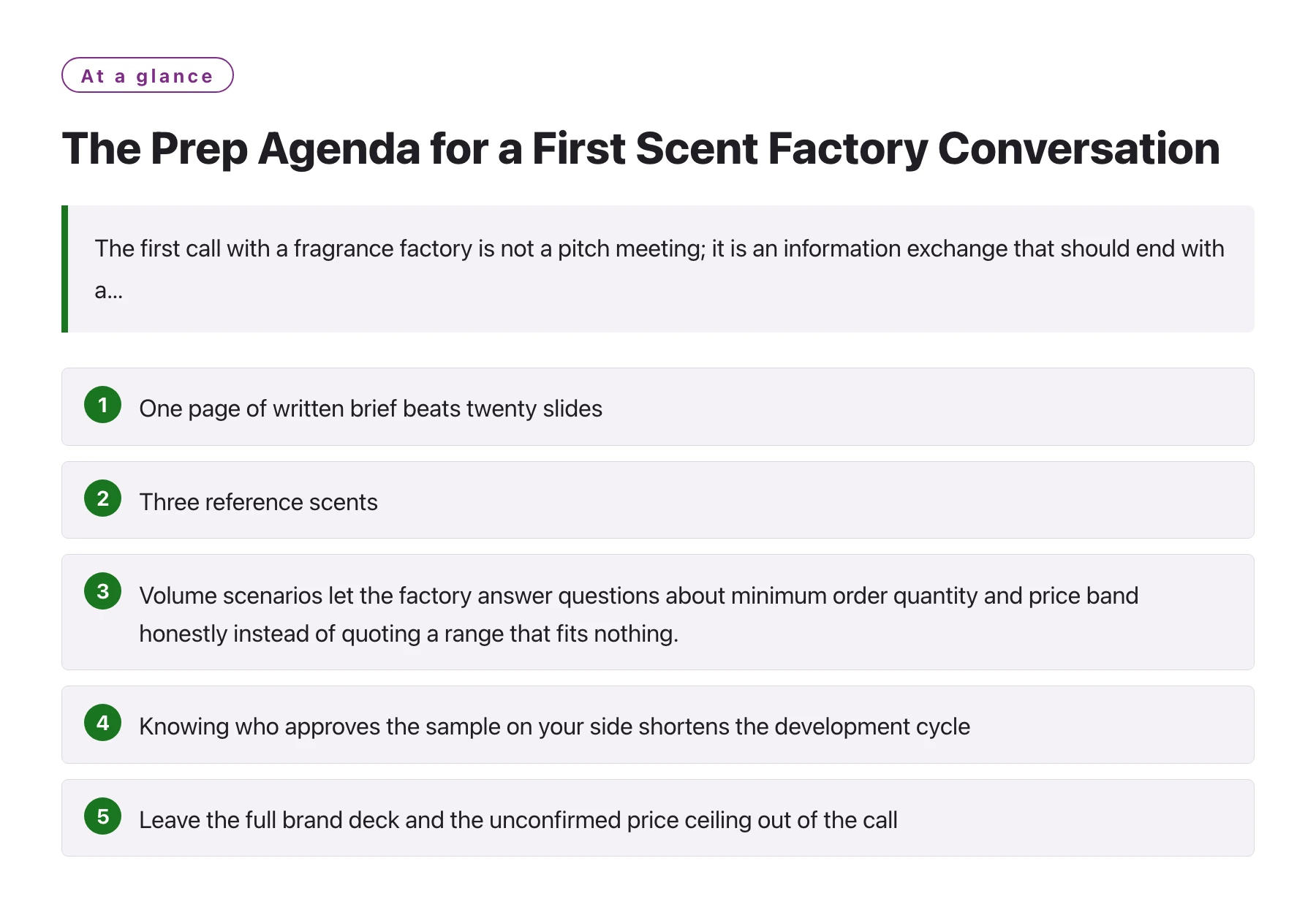
- One page of written brief beats twenty slides, because the factory's technical team will work from the document rather than from the call.
- Three reference scents, each with a sentence about what you want from it, give a perfumer more direction than any description of a mood.
- Volume scenarios let the factory answer questions about minimum order quantity and price band honestly instead of quoting a range that fits nothing.
- Knowing who approves the sample on your side shortens the development cycle, because feedback can be consolidated rather than collected.
- Leave the full brand deck and the unconfirmed price ceiling out of the call; both invite the supplier to respond with positioning rather than costs.
- The half hour works best with a fixed agenda: brief, their questions, sampling plan, next steps in writing.
Founders often prepare for a factory call by rehearsing how to describe the brand. That is the least useful preparation, because the brand story is not what the factory produces from. What a fragrance team needs is a product description with numbers attached: what the item is, how it will be sold, where, in what volume, at what price, and by when.
The second common mistake is arriving with a dozen references and no priorities. References are valuable when they are curated and useless when they are a folder. A perfumer receiving ten directions will pick one and hope; a perfumer receiving three with a stated reason for each can build a brief that is likely to land.
This is a preparation pack and a call agenda, designed for a first conversation about a seasonal range, and for the follow-up email that should contain the sampling plan by the end of the day.
What to bring, and what to leave out
| Bring to the call | Why it earns its place | Leave out |
|---|---|---|
| A one-page brief: product, format, market, price band, volume scenario, launch window | It is the document the technical team will quote from, and it can be circulated internally after the call | A long brand presentation, which uses the time that should go to technical questions |
| Three reference scents with a stated reason for each | References communicate direction faster than vocabulary, and the reason tells the perfumer which part of each scent matters | A folder of ten references with no ranking, which shifts the decision back to the supplier |
| Volume scenarios, including a low and a realistic case | Minimum order quantity, unit cost and tooling decisions all change with volume, and one number cannot represent them | A volume figure invented for the call, which produces a quote you cannot use |
| Target unit cost and what it includes | It frames the development brief and prevents a sample built at a cost the product cannot carry | An unconfirmed price ceiling described as final, which invites delay rather than honesty |
| The markets you intend to sell into | Each market has its own labelling and registration expectations, and they affect what can be shipped | A vague global ambition that defers every compliance question |
| The status of packaging and any existing component suppliers | It decides whether the quote covers sourcing and decoration or only filling | A design that is still open, unless you want feedback on feasibility rather than a quote |
| Your list of questions, written down | Written questions get written answers, which is what makes a comparison between suppliers possible | Questions you have not decided the answer will change anything |
The pattern is simple: bring the facts a factory needs to answer, and leave out the material that only decorates them.
Building the one-page brief
The brief does not need to be elegant. It needs six facts in a predictable order, so the person reading it can find what they need without interpreting. Write the product in one line: eau de parfum, 50 ml, spray, for a spring seasonal range. Then the market and channel, the price band, the volume scenario, the launch window, and the constraints you already know about.
Constraints are the most valuable part and the most often omitted. If the bottle must come from an existing supplier, say so. If the retail price forces a compound cost below a certain level, say so. If the range has to share one bottle family, say so. Every constraint you state is a sample round you may not have to run.
Keep a short section for what you want the fragrance to do. Behaviour is more useful than mood: how long it should last, how far it should project, whether it should read clean or rich, and which moment of wear matters most. A scent that must still be pleasant after six hours on a wrist has a different brief from one judged in the first ten minutes. A team that is still assembling its reference vocabulary can shorten that work by walking through the immersive scent museum, where the point is to compare scents in a structured way rather than to admire them.
Using market information without outsourcing the decision
Published consumer research on fragrance and beauty trends can help frame which direction a seasonal brief explores, and press centres that summarise it are a reasonable starting point [1]. The caution is that a trend report describes a market, not your product. Use it to widen the options at the start, then narrow with references and price constraints.
A useful exercise before the call is to write two sentences: what the season's consumer is buying more of, and what your range will do about it. If the second sentence does not follow from the first, the brief may be chasing a trend rather than fitting one.
A 30-minute call agenda
- Minutes 0 to 5: confirm the scope of the callState what you want from the conversation: an assessment of feasibility, a sampling plan and an indication of cost. Confirm who on their side will handle development and who will quote.
- Minutes 5 to 12: walk the one-page briefRead it in order and pause at the constraints. Ask whether any constraint is a problem before moving on, because that answer changes everything that follows.
- Minutes 12 to 20: let them ask questionsThe questions a factory asks reveal how it works. Note them, answer what you can, and flag what you need to check internally rather than inventing an answer.
- Minutes 20 to 26: agree the sampling planHow many directions in the first set, expected dates, sample cost, revision rounds and what they need from you to start.
- Minutes 26 to 30: next steps and ownershipAgree who sends what by when. Ask for the follow-up in writing, including the open questions they raised.
Three questions worth asking even if time is short
Ask what happens if the first sample set misses the direction. The answer tells you whether the revision rounds are part of the development fee or a new project, and it previews how the next few months will be billed.
Ask who will be your technical contact after the call. A named developer, rather than a sales inbox, is the difference between feedback reaching the perfumer and feedback reaching a summary.
Ask what the factory needs from you that most brands deliver late. The answers are usually artwork, a decision on fill weight, and consolidated feedback. Knowing them in advance lets you schedule your own work rather than becoming the bottleneck.
If the call shows that the gap is vocabulary rather than information, treat that as a separate workstream instead of a reason to postpone the project. Structured professional scent training is built for product and brand teams rather than for perfumers, and it tends to pay for itself in fewer wasted sample rounds.
Preparing the team, not just the document
If more than one person will join the call, agree before it starts who speaks about the product, who speaks about price, and who takes notes. A call with four voices and no owner produces a friendly conversation and no decisions.
Decide in advance how the sample will be evaluated after the call. Two people testing on skin over several hours will produce better feedback than five people smelling blotters for ten minutes, and the supplier can plan around the method.
Finally, do not let the preparation become the project. A brand can spend three months polishing a brief and never reach sampling, which is a slower failure than a mediocre first call. If the pack is good enough to answer the factory's technical questions, make the call, then improve the pack using what you learned. Brands that would rather see how a developer sets out the process before they prepare theirs can start with Xuelei fragrance brand, then write the one-page brief to match the questions it raises.
Preparation is not about impressing the supplier. It is about removing the reasons a development cycle slows down, one of which is almost always a brief that arrived incomplete.
Send the one-page brief before the call, even if it is imperfect. A supplier who has read it for ten minutes will ask sharper questions in the meeting than one who hears it for the first time.
Sources
- Mintel Press Centre —— Mintel's press releases on consumer and beauty market research, including fragrance and personal care trend reporting.
Frequently asked questions
What should I prepare before the first call with a fragrance factory?
A one-page brief with product, format, market, price band, volume scenario and launch window; three reference scents with reasons; the status of packaging; the list of target markets; and your written questions.
How many reference scents should I bring to a factory call?
Three is a practical number. Fewer may leave the direction open; more tends to dilute it. For each one, state what you want from it, such as freshness, a particular dry-down or a price-appropriate structure.
Should I share my target price with a fragrance factory?
Yes, if it is a genuine target based on your retail price and margin. Withholding it usually produces a sample built at a cost your product cannot carry, and the brief has to be rebuilt later.
What should I ask about sampling on the first call?
How many directions the first set contains, the expected date, the sample fee and whether it is credited, how many revision rounds are included, and what the factory needs from you to start.
How do I follow up after the first factory call?
Send a short summary the same day: the agreed brief, the open questions, the sampling plan with dates, and who owns each item. A written follow-up turns a conversation into a project record.